
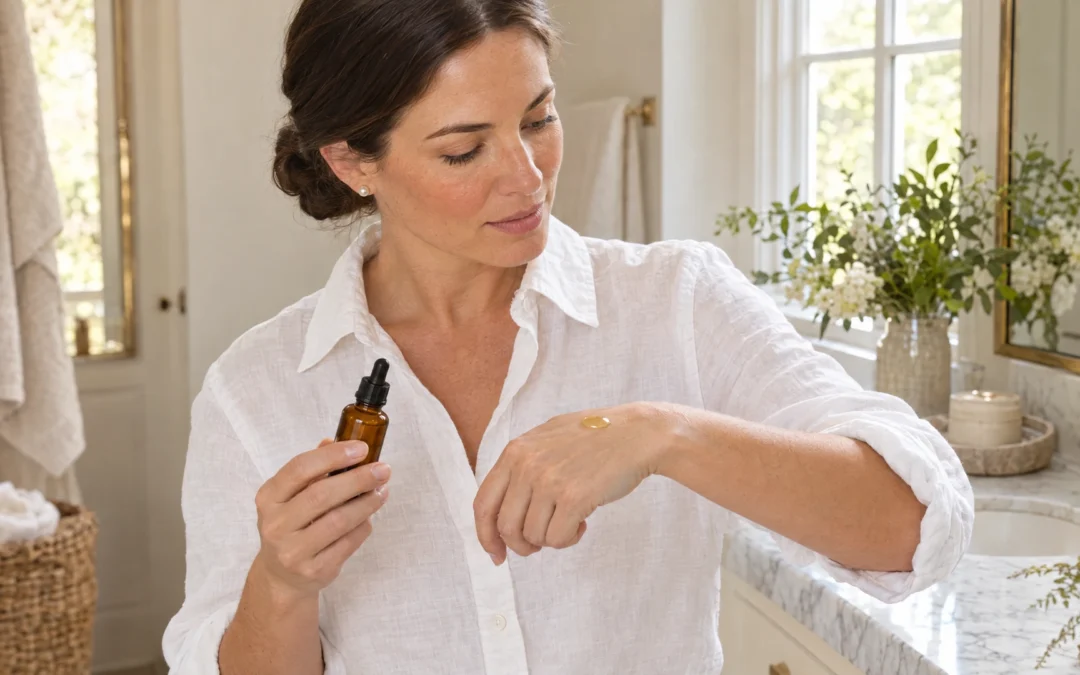


Vitamin E oil for skin is built on tocopherol, a pale yellow, viscous liquid that works as an antioxidant inside other oils. In a body oil or face serum, its job starts in the bottle, where it slows the oxidation that turns plant oils rancid. On your skin, pure vitamin E feels thick and tacky, so you get a softer feel from a few drops blended into a lighter oil, and you patch test it first.
Vitamin E earns its place in a bottle of oil long before the oil ever touches you.
You turn over a bottle of body oil, read the ingredients, and spot vitamin E in the list. You wonder what it does there, whether you want a bottle of pure vitamin E oil on your shelf, and how it feels when you press it into your skin. Those three questions deserve plain answers, without miracle talk.
This guide gives you the chemistry in everyday words, the reason makers add vitamin E to plant oils, how it feels on your hands and face, and the simple patch test dermatologists recommend before you try anything new. I read the PubChem record for alpha-tocopherol, a scientific review of tocopherols in oils, and the Cosmetic Ingredient Review panel’s safety assessment before writing this.
What Is Vitamin E Oil for Skin, Exactly?

The vitamin E on your label belongs to a small family of molecules. PubChem describes vitamin E as a generic descriptor for all tocopherols and tocotrienols that exhibit alpha-tocopherol activity. The Cosmetic Ingredient Review panel reports tocopherols, not tocotrienols, as the members that work as antioxidants in cosmetics, so tocopherol is the name to look for on your label.
The name carries a history you will enjoy. Researchers discovered vitamin E in 1922, isolated it in 1935 and first synthesized it in 1938. They named it tocopherol from Greek words meaning birth and to bear or carry. The ending “-ol” signals its status as a chemical alcohol, so your label hides a small Greek lesson in plain sight.
In its pure form, vitamin E looks nothing like the clear, slippery oils you know. PubChem records alpha-tocopherol as a pale yellow viscous liquid. PubChem also lists it as insoluble in water. Pour it and it moves slowly, in a thick golden stream, so keep that weight in mind when you choose a bottle for your skin.
You also see a second name on labels: tocopheryl acetate. PubChem classes tocopheryl acetate as an ester of vitamin E. PubChem also notes it is the most common form of vitamin E used in sunscreen and skin care products. Plain tocopherol and tocopheryl acetate share a family name, so read your ingredient list closely if you want to know which one sits in your bottle.
Vitamin E on a label, decoded
- Tocopherol: the plain form, a pale yellow viscous liquid
- Tocopheryl acetate: an ester form, common in skin care products
- Vitamin E: the everyday name that covers the whole family
Why Vitamin E Goes Into a Bottle of Body Oil

Here is the job that matters most for your bottle. Plant oils react with oxygen over time. A scientific review of tocopherols in oils explains that the first stage of that reaction strips a hydrogen atom from a fatty acid, and that light or heat speeds it up. As the reaction moves on, it breaks down into aldehydes and ketones, and those change the smell and taste of the oil in a way people describe as rancidity.
Vitamin E steps into that chain reaction. PubChem lists alpha-tocopherol as used as an antioxidant in oils. The same review explains how: the action mechanism of vitamin E consists of the donation of a phenolic hydrogen atom to a peroxyl radical. In plain words, vitamin E interrupts the chain reaction, so the oil in your bottle holds its fresh scent and clean feel for longer.
More is not always better for your oil. The review notes that makers often add antioxidants to oils at very low concentrations. It also reports that tocopherols applied at higher concentrations act as a prooxidant molecule, so a small amount of vitamin E suits your blend better than a heavy pour.
The Cosmetic Ingredient Review Expert Panel assessed the safety of 14 tocopherols and tocotrienols and concluded these ingredients are safe as used in cosmetics. The same assessment reports that tocopherols function in cosmetics as antioxidants or skin-conditioning agents. That is the honest scope of the ingredient: it guards the oil and it leaves your skin feeling conditioned.
You find vitamin E in two of our blends. Amber Veil Luxury Body Oil pairs it with fractionated coconut, jojoba and meadowfoam seed oils. Golden Veil Botanical Face Serum blends it with jojoba, meadowfoam and virgin passionfruit seed oil. Amber Veil costs $36, and the serum costs $48. Want the background on those carriers? Read our guide to fractionated coconut oil and our look at jojoba oil for your face.
How Vitamin E Oil Feels on Your Skin

Feel is where your own judgment takes over. Rub a drop of pure vitamin E between your fingers and you notice the weight first: it drags, it clings, and it leaves a tacky film that takes a while to settle. That matches its viscous texture in the bottle. On your hands or face, a full drop of pure vitamin E sits on top of your skin instead of sinking in.
Blend it and the feel changes for you. A few drops of a vitamin E oil mixed into a lighter carrier, such as jojoba or fractionated coconut oil, loses the tackiness and leaves a soft, satin finish with a faint golden sheen. If you want to build your own blend, our guide to carrier oils for essential oils walks you through how each base feels.
Timing matters as much as the blend. Press body oil into your skin while it is still damp from the shower, so the oil spreads thin and even instead of sitting in streaks. Our body oil ritual reads: “Warm three or four drops between the palms and press into skin straight after a shower, while the air still holds the steam.” For your face, the serum ritual reads: “Press two or three drops into clean, slightly damp skin morning and night.”
Keep your expectations honest and your routine simple. Vitamin E shapes how the oil keeps in the bottle and how it feels on you, so judge any vitamin E oil you try by its scent, its texture and its freshness.
How to use vitamin E oil for a soft finish
- Choose a blend where vitamin E sits inside lighter carrier oils
- Apply to damp skin straight after a shower or a face rinse
- Use three or four drops for your body, two or three for your face
- Press the oil in with flat palms rather than rubbing it
- Give it a minute or two before you dress or apply makeup
How to Patch Test and Store Vitamin E Oil

Any new oil deserves a test run on you before it goes on your face. The American Academy of Dermatology describes a simple home test. Apply the product to a test spot twice daily for seven to 10 days. Choose a quarter-sized spot where the product will not get rubbed or washed away, such as the underside of your arm or the bend of your elbow, and use the normal amount you would apply in your routine.
Watch the spot and trust what you see. If after seven to 10 days you have no red, itchy or swollen skin, the AAD says to go ahead and use the product. If you do see a reaction, wash the product off as soon as possible and do not use it again. The AAD also notes that a skin care ingredient, such as a preservative, sometimes triggers an allergic reaction, so a clean test on one oil tells you about that oil alone.
Good storage backs up the work vitamin E does in the bottle. Light and heat speed up the oxidation that leads to rancidity, so keep your oils in a cool cupboard rather than on a sunny windowsill or beside a steamy shower. Cap the bottle tightly after each use so less fresh air reaches the oil.
Patch test and storage checklist
- Test twice daily for seven to 10 days on the underside of your arm or the bend of your elbow
- Stop and wash the oil off if you see redness, itching or swelling
- Store oils away from light and heat
- Cap the bottle tightly after every use
- Smell the oil before you use it, and set it aside if it no longer smells like its blend
Trust your nose. A fresh oil smells of its blend. As an oil oxidizes, its breakdown products change its smell and taste in the way people describe as rancidity, so an off smell tells you the oil has turned. Our guide on whether essential oils expire walks you through more storage habits, and if you plan to carry your oils on a trip, read our guide to bringing perfume on a plane before you pack.
My honest opinion: skip the bottle of pure vitamin E oil and look for it inside a blend you already love. You get the bottle-side benefit of a fresher oil, and you get a texture you enjoy wearing every day.
Vitamin E Oil for Skin: Your Questions Answered
Is vitamin E oil good for your face?
That depends on how it feels to you. Pure vitamin E feels thick and tacky on your face, so you might prefer it blended into a lighter oil like jojoba. Patch test any new face oil on the underside of your arm for seven to 10 days first, the way the AAD recommends, then press two or three drops into damp skin.
What is vitamin E oil made of?
The vitamin E itself is a pale yellow viscous liquid. PubChem lists it as insoluble in water, so you find it in oils and oil blends rather than in water. Read the label on your bottle to see whether your vitamin E oil comes blended into a lighter carrier oil.
What is the difference between tocopherol and tocopheryl acetate?
Tocopherol is the plain form of vitamin E, and tocopheryl acetate is an ester of it. PubChem lists tocopheryl acetate as the most common form of vitamin E in sunscreen and skin care products, so check your label to see which one your bottle holds.
Why do brands add vitamin E to body oil?
To protect the oil itself. Vitamin E works as an antioxidant in oils, slowing the oxidation that turns plant oils rancid, so your bottle keeps its fresh scent longer.
Does more vitamin E make an oil last longer?
Not always. A scientific review of tocopherols in oils reports that at higher concentrations they act as a prooxidant. Makers often add antioxidants to oils in small amounts, so your bottle needs only a little.
How do you know if your vitamin E oil has gone rancid?
Smell it. Rancidity changes how an oil smells, so a bottle that no longer smells like its blend has turned. If your bottle smells off, set it aside and open a fresh one.
Vitamin E, in the blend
Press three or four drops of a vitamin E body oil into damp skin tonight and feel the satin finish for yourself.
Like this article? Add Piton Noir Botanicals as a preferred source, and you are more likely to see our articles in Google’s Top Stories.