

An essential oil dilution chart tells you how many drops of essential oil to add to your carrier oil for a given strength, and for a body oil most guidance lands at 1 to 3 percent, about 9 to 27 drops in a 30 ml (1 oz) bottle. Your face wants less, around 1 percent, and a few oils such as clove bud and lemon need a lighter hand still.
Dilution is the line between a scent you wear every day and a bottle you never open again.
You found the perfect essential oil, and now the label says dilute before use. It does not say how much. Ask three websites and you get three different numbers, a pile of drop counts and a math problem you never signed up for when you bought a bottle that smells like a garden.
This guide gives you a clear essential oil dilution chart for the bottle sizes you use most, explains what the percentages mean, shows you the right strength for your face, your body and your bath, and flags the oils that need extra care. I read the Tisserand Institute dilution chart, its general dilution guide and the NAHA safety page before writing this, and every number below comes from those sources so you check them yourself. If you still need to choose your base, start with our guide to carrier oils for essential oils.
What Does an Essential Oil Dilution Percentage Mean?
A dilution percentage tells you how much of your finished blend is essential oil. A 2 percent body oil holds 2 parts essential oil to 98 parts carrier oil. The number sounds small because it is meant to be small. As the Tisserand Institute safety guidelines point out, the essential oil in your bottle is 50 to 100 times more concentrated than in the plant it came from.
Dilution and risk move together. The same page names undiluted use as the most common cause of skin reactions and states the rule without hedging: do not apply undiluted essential oils to your skin. A lower percentage lowers your risk, and for most of your everyday blends it still gives you plenty of scent.
Drops are an approximation, and the chart says so: its values are approximate and rounded to whole drops. Read every drop count as a close guide rather than a lab measurement, and measure your carrier oil carefully so your ratio holds from one batch to the next.
The Essential Oil Dilution Chart for 10 ml and 30 ml Bottles
These figures come from the Tisserand Institute essential oil dilution chart. The chart counts total drops, so in a blend you add up every essential oil you use. It also notes that a given strength is not automatically right for every oil in every situation, so read the section on oils that need a lighter hand before you mix.
| Strength | Drops in 10 ml of carrier oil |
|---|---|
| 0.5 percent | 1 drop |
| 1 percent | 3 drops |
| 2 percent | 6 drops |
| 3 percent | 9 drops |
| 4 percent | 12 drops |
| 5 percent | 15 drops |
| Strength | Drops in 30 ml (1 oz) of carrier oil |
|---|---|
| 0.5 percent | 4 drops |
| 1 percent | 9 drops |
| 2 percent | 18 drops |
| 3 percent | 27 drops |
| 4 percent | 36 drops |
| 5 percent | 45 drops |
Need a different bottle size? The same chart lists 2 percent at 9 drops for a 15 ml (1/2 oz) bottle, 30 drops for 50 ml and 36 drops for 60 ml (2 oz). Scale from those and you never have to guess again.
How to dilute essential oils, step by step
- Pick your strength from the guide below, based on where the blend goes
- Measure your carrier oil into a clean amber glass bottle
- Count your essential oil drops from the chart, adding every oil in the blend together
- Cap, roll gently between your palms, and label it with the date and the strength
- Patch test on your inner forearm before you use it widely
How Strong Should Your Blend Be? Dilution by Use
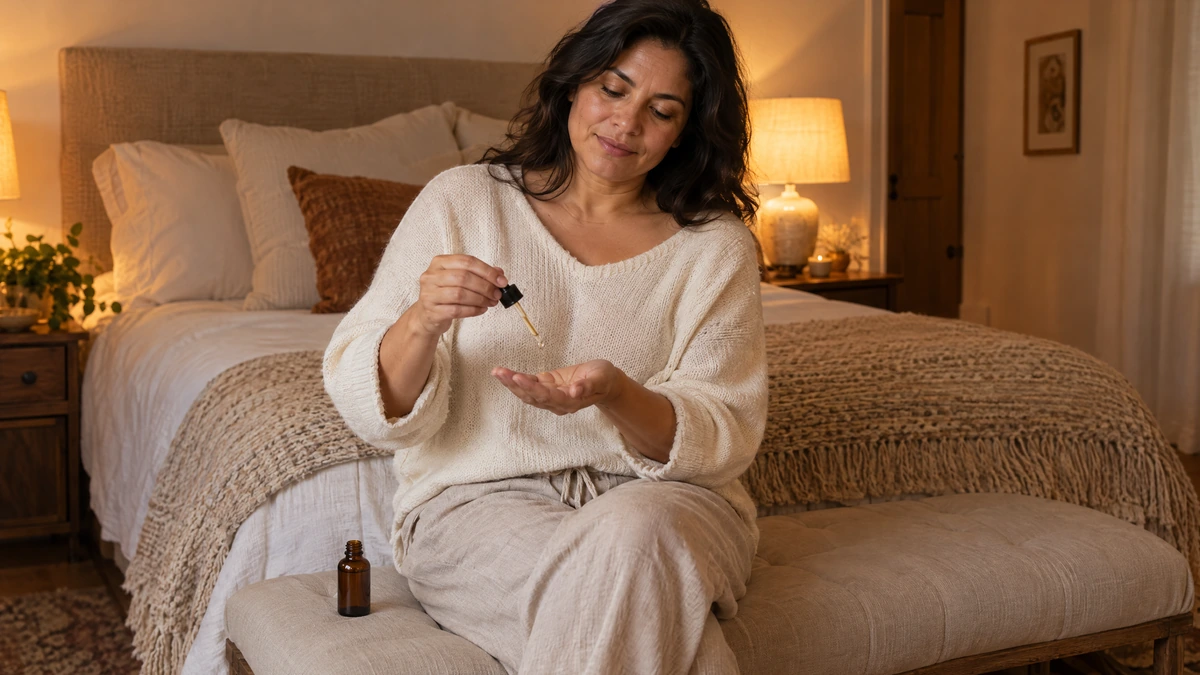
Where the blend goes decides how strong it should be. The Tisserand Institute’s general dilution guide sets these ranges for everyday use, and the most common choice in each range gives you a sensible starting point for your own blends.
General dilution guide from the Tisserand Institute
- Facial products and deodorants: 0.2 to 1.5 percent, most often 1 percent
- Body oils and lotions: 1 to 3 percent, most often 2 percent
- Bath products: 2 to 4 percent, most often 3 percent
Those body oil figures assume you cover a large area. Tisserand notes that for adults the percentages apply to full-body use, and that more concentrated dilutions work for small, local areas of skin. A roller blend you dab on your wrists sits in a different place from an oil you spread across your back and legs.
Your bath needs its own rule. Essential oils do not mix with water. They float in tiny droplets, and you sit right on top of them. Tisserand advises you to disperse essential oils fully in a suitable base before they go into the tub, and its bath safety notes explain why Epsom salts and milk do not work as dispersants.
Children need a gentler hand again. NAHA’s safety guidance says infants, toddlers and young children are more sensitive to essential oils and places safe dilutions for them generally between 0.5 and 2.5 percent. Tisserand adds a rule you should follow in every home: keep your essential oil bottles where young children cannot reach them.
The Essential Oils That Need a Lighter Hand

A percentage that suits one oil overreaches for another. The Tisserand Institute dilution chart page calls out a few oils by name, and you should know them before you blend anything for your skin.
Oil-specific limits from the Tisserand Institute
- Clove bud: no more than 0.5 percent, to avoid the risk of skin allergy
- Holy basil: up to 1 percent, for the same reason
- Lemon: no more than 2 percent, to avoid the risk of phototoxicity
- Grapefruit: up to 4 percent, for the same reason
Phototoxicity is a skin reaction that shows up when sunlight reaches skin where you applied certain oils. NAHA lists bergamot, expressed lemon, expressed lime and expressed bitter orange among the common photosensitizers, along with angelica root, cumin and rue. If you love a bright citrus note on your skin, keep those blends for evening or for skin you cover, and see our guide to what bergamot smells like.
Some oils irritate at almost any strength. NAHA names cinnamon bark, clove bud, lemongrass, oregano and thyme ct. thymol among common dermal irritants and recommends a skin patch test whenever you suspect sensitive skin. For these, a lower percentage than the chart suggests is the smarter choice for your skin.
If you would rather leave the math to someone else, our finished blends arrive ready for your skin. Golden Veil Botanical Face Serum ($48) sits on jojoba, meadowfoam and virgin passionfruit seed oil with notes of ylang ylang, passionfruit, amyris and vanilla. Moonlight Descent Luxury Body Oil ($36) carries neroli, gardenia, white musk and teakwood on fractionated coconut and meadowfoam seed oils. Press two or three drops of the serum into slightly damp skin, or warm three or four drops of the body oil between your palms after a shower.
My honest opinion: most people dilute too strong, not too weak. A blend that smells loud in the bottle settles into something lovely at 1 or 2 percent once it warms on your skin, and you get to wear it every day instead of once. Start low, live with it for a week, and only then decide whether you want more.
Essential Oil Dilution: Your Questions Answered
How many drops of essential oil go in an ounce of carrier oil?
For a 2 percent body oil, about 18 drops in 30 ml (1 oz) of carrier oil. A 1 percent face blend takes about 9 drops in the same 30 ml, and 3 percent takes about 27, according to the Tisserand Institute chart you see above.
What is a safe dilution for essential oils on your skin?
For most adult body use, 1 to 3 percent, with 2 percent the most common choice. NAHA notes that most oil-based blends fall between 1 and 5 percent, and both sources ask for less on your face and for children.
What is the best dilution for your face?
The Tisserand Institute guide puts facial products at 0.2 to 1.5 percent, most often 1 percent. In a 10 ml bottle, that comes to about 3 drops of essential oil for your face.
Can you put essential oils straight into the bath?
No. Essential oils float on water in tiny droplets that sit directly on your skin. Disperse them fully in a suitable base first, as the Tisserand Institute recommends, and skip Epsom salts and milk as dispersants.
Do you count the drops of every essential oil in a blend?
Yes. The chart counts the total of all essential oils combined. A 2 percent blend in 30 ml means about 18 drops in total, whether that is one oil or three you mix together.
Which essential oils need a lower dilution?
Clove bud stays at or below 0.5 percent and holy basil at or below 1 percent to avoid the risk of skin allergy, and lemon stays at or below 2 percent to avoid phototoxicity, per the Tisserand Institute. Handle strong spice oils such as cinnamon bark and oregano on your skin with the same care.
Start low, wear it daily
Blend at the strength your skin welcomes, or choose a finished oil and press it into damp skin tonight.
Like this article? Add Piton Noir Botanicals as a preferred source, and you are more likely to see our articles in Google’s Top Stories.